


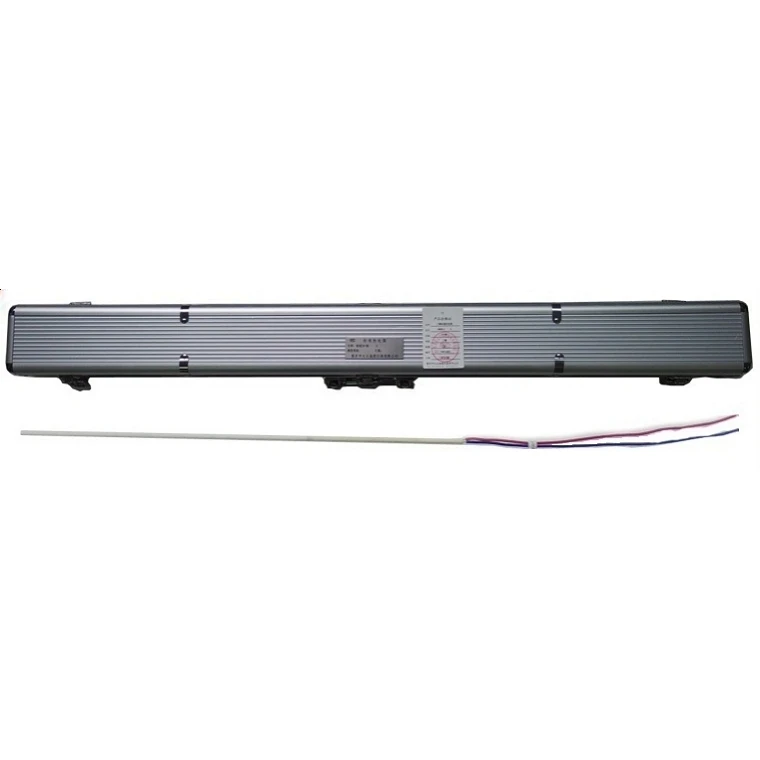


I. Core Parameters
|
Item |
Details |
|
Thermocouple Type |
Class II standard platinum-rhodium thermocouple (WRPB-2), paired with Class I standard model WRPB-1 |
|
Electrode Material |
Positive electrode: Platinum-rhodium 10 alloy wire (PtRh10); Negative electrode: Pure platinum wire (Pt) |
|
Temperature Measurement Range |
0~1084.62℃ (standard temperature range, covering routine verification needs of industrial thermocouples) |
|
Measurement Accuracy |
Class II standard level accuracy, with excellent thermoelectric potential stability and repeatability, meeting metrological verification requirements |
|
Product Specification |
Dimension: Φ0.5mm×1000mm (diameter × total length) |
|
Calibration Cycle |
Calibration at least once every 6 months to ensure value accuracy |
|
Annealing Parameters |
Electric annealing: Apply 10.5A current at 1100℃ for 1 hour |
|
Applicable Atmosphere |
Oxidizing atmosphere, neutral atmosphere; Prohibited for use in reducing atmosphere and carbon-containing atmosphere |
|
Executive Standards |
Complies with national standards for metrological verification and IEC 60584 international standard |
|
Safety Certifications |
CE, ISO 9001 quality management system certification, SIL 2 functional safety level (complies with IEC 61508:2010) |
II. Product Features
High-Precision Value TransmissionAs a Class II standard instrument, its accuracy meets the requirements of industrial thermocouple verification, enabling accurate transmission and traceability of temperature values.
Stable Thermoelectric PerformanceElectrodes adopt high-purity platinum-rhodium alloy and pure platinum materials, featuring strong thermoelectric potential stability, good repeatability, and small error drift during long-term use.
Excellent High-Temperature Oxidation ResistanceThe noble metal material has good high-temperature oxidation resistance within the range of 0~1084.62℃, adapting to high-temperature calibration and measurement scenarios.
Standardized Structural DesignFixed specification (Φ0.5mm×1000mm) paired with a double-hole insulated ceramic tube, complying with the unified adaptation requirements of metrological verification equipment.
Complete and Standard Supporting ConfigurationIncluding electrode wire, insulated ceramic tube, identification sleeve, and glass storage shell. The full set of configurations meets the needs of direct use and proper storage.
Strong TraceabilityThe product is accompanied by a calibration certificate with a one-to-one corresponding number, supporting value traceability and meeting metrological management requirements.
III. Related Component Specifications
|
Component Name |
Specification Details |
|
Electrode Wire |
Diameter Φ0.5mm; Positive electrode (PtRh10), Negative electrode (Pt); High-temperature resistance up to 1084.62℃, high purity, stable thermoelectric performance |
|
Insulated Ceramic Tube |
Double-hole structure, length 550mm; Material: High-temperature resistant ceramic with excellent insulation performance to prevent electrode short circuit |
|
Identification Sleeve |
Positive electrode: Red/pink plastic sleeve; Negative electrode: White/blue plastic sleeve for easy distinction of positive and negative electrodes |
|
Storage Shell |
Glass material for product storage, moisture-proof and dust-proof, protecting the electrode wire from damage |
|
Calibration Certificate |
With exclusive number, one-to-one corresponding to the product, recording calibration data and value traceability information |
|
Auxiliary Tools |
Equipped with annealing-related terminals, adapting to 10.5A electric annealing operation |
IV. Application Scenarios
Core Application Fields
Metrological Verification InstitutionsUsed for factory inspection and periodic calibration of industrial thermocouples (such as Type K, Type S) to ensure the accuracy of industrial temperature measuring equipment;
Scientific Research ExperimentsHigh-precision temperature measurement experiments in universities and research institutes, as well as research projects related to temperature metrology;
High-End Industrial ProductionTemperature monitoring in production processes with extremely high requirements for temperature measurement accuracy, such as aerospace, semiconductors, and precision metallurgy;
Quality Inspection DepartmentsIn internal quality control of enterprises, used for calibrating industrial thermocouples used on the production site to ensure the stability of product production processes.
Typical Cooperative Customers
National Institute of Metrology, China, metrology and testing research institutes of various provinces and cities, China Aerospace Science and Technology Corporation, SMIC, Tsinghua University, Institute of Metrology, Chinese Academy of Sciences, and other metrological institutions, scientific research universities, and high-end manufacturing enterprises.
V. Product Advantages
Standard-Level Accuracy GuaranteeDesigned as Class II standard, its accuracy meets the requirements of metrological verification, serving as a reliable carrier for accurate transmission of temperature values.
Superior Material PerformanceAdopting high-purity noble metal electrodes, its high-temperature oxidation resistance and thermoelectric potential stability are far superior to ordinary thermocouples, with a long service life.
Complete and Standard Supporting ConfigurationIncluding insulated ceramic tube, identification sleeve, glass storage shell, and calibration certificate, ready to use out of the box without additional configuration.
Strong TraceabilityThe calibration certificate can be traced back to the national metrological primary standard, complying with the requirements of the metrological management system and suitable for compliance testing scenarios.
Convenient Operation and MaintenanceStandardized size adapts to conventional verification equipment, with simple annealing process and clear calibration cycle, resulting in low maintenance costs.
Authoritative Technical EndorsementThe enterprise has many years of experience in R&D and production of thermocouples, participates in the formulation of relevant standards, and product quality has been verified by the long-term market.
VI. Frequently Asked Questions (FAQs)
Q: Why must the product number be consistent with the calibration certificate number?
A: The one-to-one correspondence of numbers is the core basis for value traceability, which can ensure the authenticity and validity of the calibration data of the thermocouple used. It meets the compliance requirements of metrological verification and avoids measurement deviations caused by using uncalibrated products or products with mismatched calibration data.
Q: Why is it prohibited for use in reducing atmospheres?
A: Platinum-rhodium and pure platinum materials are easily contaminated in reducing atmospheres, leading to decreased thermoelectric potential stability, precision drift, and even electrode damage, affecting the accuracy of value transmission. Therefore, they can only be used in oxidizing or neutral atmospheres.
Q: What is the purpose of electric annealing?
A: Annealing can eliminate internal stress generated in the electrode wire during use or transportation, restore thermoelectric potential stability, and ensure measurement accuracy. It is recommended to perform annealing after each calibration or before use.
Q: Are there other cleaning and maintenance methods besides electric annealing?
A: The electrode wire can be taken out from the double-hole ceramic tube, straightened, and then the surface of the positive and negative electrodes can be wiped with ethanol to remove stains and oxide layers. After cleaning, thread it back into the ceramic tube according to the positive and negative marks. Do not use corrosive cleaning agents.
Q: Can the product be directly used for long-term temperature measurement on the industrial production site?A: It is mainly used for verification and calibration. If used for on-site temperature measurement, two conditions must be met: ① The working condition is oxidizing/neutral atmosphere; ② Calibrate strictly according to the 6-month cycle, and avoid severe vibration and pollution. Otherwise, it will accelerate electrode wear and affect accuracy.
Q: What is the difference between WRPB-1 and WRPB-2?A: WRPB-1 is a Class I standard thermocouple with higher accuracy, mainly used for calibrating Class II standards such as WRPB-2; WRPB-2 is a Class II standard used for the verification of industrial thermocouples. The two form a value transmission chain for metrological verification.
VII. Usage and Maintenance Instructions
Before use, check that the product number is consistent with the calibration certificate number and confirm that it is within the calibration validity period. Avoid using expired and uncalibrated products.
During installation, ensure that the electrode insertion depth meets the measurement requirements, and the double-hole ceramic tube completely wraps the electrode to prevent electrode short circuit or contamination.
Strictly use it in the specified atmosphere, away from reducing gases, carbon-containing media, and corrosive environments to protect the performance of the electrode material.
Contact qualified institutions for calibration according to the 6-month cycle. Perform electric annealing in a timely manner after calibration to restore performance stability.
When cleaning, only wipe the electrode surface with ethanol. Do not grind or scratch with hard objects to avoid damaging the electrode wire and affecting accuracy.
When storing, place the product in a glass shell. The storage environment should be dry and well-ventilated (humidity ≤60%RH), away from high temperature, magnetic fields, and pollutants.
Product details

Insights into our company


Insights into our production

Manual Welding

Automatic Welding

Insulation Testing

Laser Marking

Warehouse Managing

Thermocouple Assemble

Vacuum Leak Detection

Surface Polishing
Quality Certifications


Hot Tags: wrpb-2 calibrated thermocouple, China wrpb-2 calibrated thermocouple manufacturers, factory, Type B Thermocouple