


Tungsten Rhenium Thermocouple Below 1700℃
Your Professional Tungsten Rhenium Thermocouple Below 1700℃ Supplier
Chongqing Duchin Instrument Co., Ltd. specializes in the research, development, manufacturing, and distribution of temperature sensors and related equipment. The company’s primary product offerings include thermocouples, resistance temperature detectors (RTDs), compensation cables, electric heaters, thermocouple vacuum calibration devices, and composite metal protective tubes. In addition, the company undertakes instrumentation and control system projects based on customer requirements.


Why Choose Us
Team & Service
Our team is a dynamic,Quickly respond to customer needs, experienced technical team, provide design and customization services.
Wide Range of Applications
Our products are widely used in FTTH (Fiber to the Home) and FTTA (Fiber to the Antenna) applications.
Our Certificates
We have established a quality assurance system compliant with ISO9001 standards. Our products are strictly tested according to IEC, GR-326-Core, GR-3120-Core, GR-771-Core, and GR-1221-Core standards to ensure superior performance and reliability.
Broad Market
Our products are exported to a wide range of Market layout in Asia, Europe, Middle east, North America, South America, Africa.Products are exported over 50 countries, and are widely recognized by customers.
Parameter
|
Protection tube |
Tube OD |
Insulators |
Max.Temp ℃ |
Application |
|
99% Al2O3 |
Φ8,12,16 |
99% Al2O3 |
1600 |
Vacuum , Inert |
|
(Al2O3+Mo) Double Tubes |
Φ16,25 |
99% Al2O3 |
1600 |
Air |
Types of Tungsten Rhenium Thermocouple Below 1700℃
The tungsten rhenium thermocouple below 1700℃ produced by our company mainly include the following types:
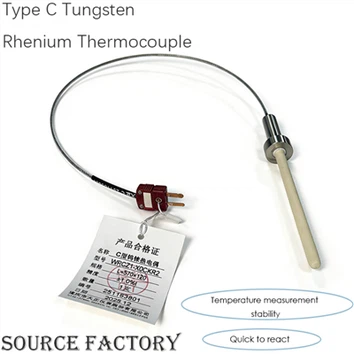
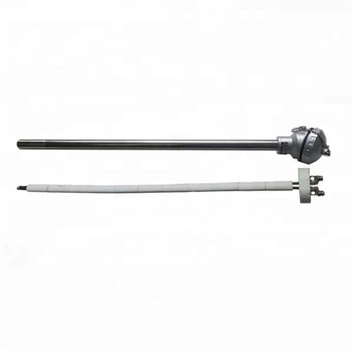
Tungsten Rhenium Ceramic Thermocouple
Tungsten-rhenium thermocouple is currently the highest temperature-measuring thermocouple. Its major usage is to measure temperature in vacuum, hydrogen, and inert atmosphere. The maximum measuring temperature reaches 2500℃.
Tungsten Rhenium Alloy Thermocouples
Tungsten-rhenium alloy thermocouples are specialized temperature sensors used for measuring extremely high temperatures, often beyond the capabilities of standard thermocouples. They typically consist of two wires, one made of tungsten and the other an alloy of tungsten and rhenium, or two different tungsten-rhenium alloys.
Characteristics of Tungsten Rhenium Thermocouple Below 1700℃
● C,D,A types.
● 0.5mm standard diameter.
● With 99%Al2O3 protection probe.
● Connectors and junction box are commonly used to connect the wires.
● To combat highly pressurized vacuum environment, our clients can bringing up the needs to customize integrated anti-high-pressure device on the thermocouple.

Applications of Tungsten Rhenium Thermocouple Below 1700℃
High-Temperature Furnaces
Utilized in industrial furnaces that operate at very high temperatures.
Aerospace
Applied in aerospace for testing and monitoring high-temperature components.
Metallurgy
Employed in the metallurgical industry for processes involving molten metals and other high-temperature operations.
Power Generation
Used in power plants, particularly in environments where very high temperatures are present.

Precautions for Using Tungsten Rhenium Thermocouple Below 1700℃
1. According to the upper limit of the temperature to be measured, the thermocouple and protective sleeve are correctly selected, and the specifications and dimensions of the thermocouple are selected according to the structure and installation characteristics of the object to be measured.
2. The position where the thermocouple is inserted into the furnace should be a representative place of the temperature in the furnace, and its temperature can represent the actual temperature in the furnace.
3. The depth of the thermocouple inserted into the furnace should not be less than 8-10 times the outer diameter of the thermocouple protection tube, and it should be placed as vertically as possible to prevent deformation at high temperatures. If it must be placed horizontally, the protective tube must be supported when the length of the projected part is greater than 500mm.
4. The gap between the thermocouple and the furnace wall must be blocked with asbestos rope or refractory mud to prevent air convection from affecting the accuracy of temperature measurement.
5. There should be a proper distance between the thermocouple junction box and the furnace wall, generally not less than 200mm. Otherwise, the temperature of the free end of the thermocouple will be too high. When measuring the temperature of the salt bath furnace, a right-angle wire thermocouple should be used.
6. The installation position and direction of the thermocouple should avoid the interference of strong magnetic field, and the metal shell should be well grounded, so as not to affect the accuracy of measurement. If it is used in the electrode salt bath furnace, be careful not to approach the electrode.
7. The welding method of the positive and negative working ends of the thermocouple can be butt welding or welding after twisting, but the number of twisting turns should not exceed 3 turns.
8. Correctly select the compensation wire. When connecting the compensation wire, be careful not to connect the wire reversely. It is better to install the compensation wire in the iron pipe and ground the iron pipe to avoid mechanical damage and electromagnetic interference.
9. The gap between the compensation wire and the outlet hole of the junction box should be blocked with asbestos rope to prevent insects from entering.
10. Be careful when installing or unpacking the furnace, and do not hit the thermocouple.
11. Since thermocouples will oxidize, corrode and recrystallize at high temperatures, their thermoelectric characteristics will change, so they should be checked regularly; new thermocouples or thermocouples stored for a period of time must be checked before use.
12. In use, pay attention to the condition of the thermocouple protection tube. If the surface of the protection tube is found to have pitting, foam, corrosion, thinning, cracking, etc., it should be replaced immediately.

Ordering Process
Send your detailed request→Feedback with quotation→Confirm price and some details →Provide PI→ Make payment→Start production→Quality checking→Delivery→After service.
Packaging and Shipping
|
Packaging |
Shock-Resistant Packaging |
|
Shipping |
We ship by Express, by air, by sea, by train. Normally we checked and compare, then provide customer the most proper shipment method. |


Our Factory
The establishment of Chongqing Duchin Instrument CO., LTD was marked in 1995, located at No. 290 Fengshixing Road, Beibei District, covers area over 11'000m2.


Certifications


FAQ
As one of the leading tungsten rhenium thermocouple below 1700℃ manufacturers in China, we warmly welcome you to buy tungsten rhenium thermocouple below 1700℃ made in China here from our factory. All customized products are with high quality and competitive price.