Thermal Resistance RTDS

Your professional Thermocouples & Rtds Manufacturer In China

Chongqing Duchin Instrument CO., LTD is a leading supplier in the manufacturing of thermocouples and rtd sensors in China.We've been dedicating to the temperature sensors industry for 29 years so far. And now, we possess more than 30 industry leading patents and products.

High Quality

With almost 29 years of industry experience, we are the experts in the field of manufacturing and calibration of temperature sensors,getting certificated by IS0 9001 Quality Management System and ISO 14001 Environmental Management System,with EX NEPSI,CE and SIL2 Certifications.

Professional Team

Duchin is working on process improvement, hiring the right employees and putting them through a series of training stages properly, and keying on communicating customer’s needs to ensure its goal of a 100% Quality Rating and Satisfaction is not missed out.

Cost Effective

Duchin not only has extensive product line and support to help our customers improve the quality of their products, but also with stable materials resources to ensure favorable prices with high quality.

Excellent service

Duchin wins trust and receives a great reputation from clients by offering high-quality products and superb 24-hour service. We also provide shock-proof packaging to ensure the product is in good condition.


First 12 Last 1/2
productcate-2538-1163


What is a Rtd?

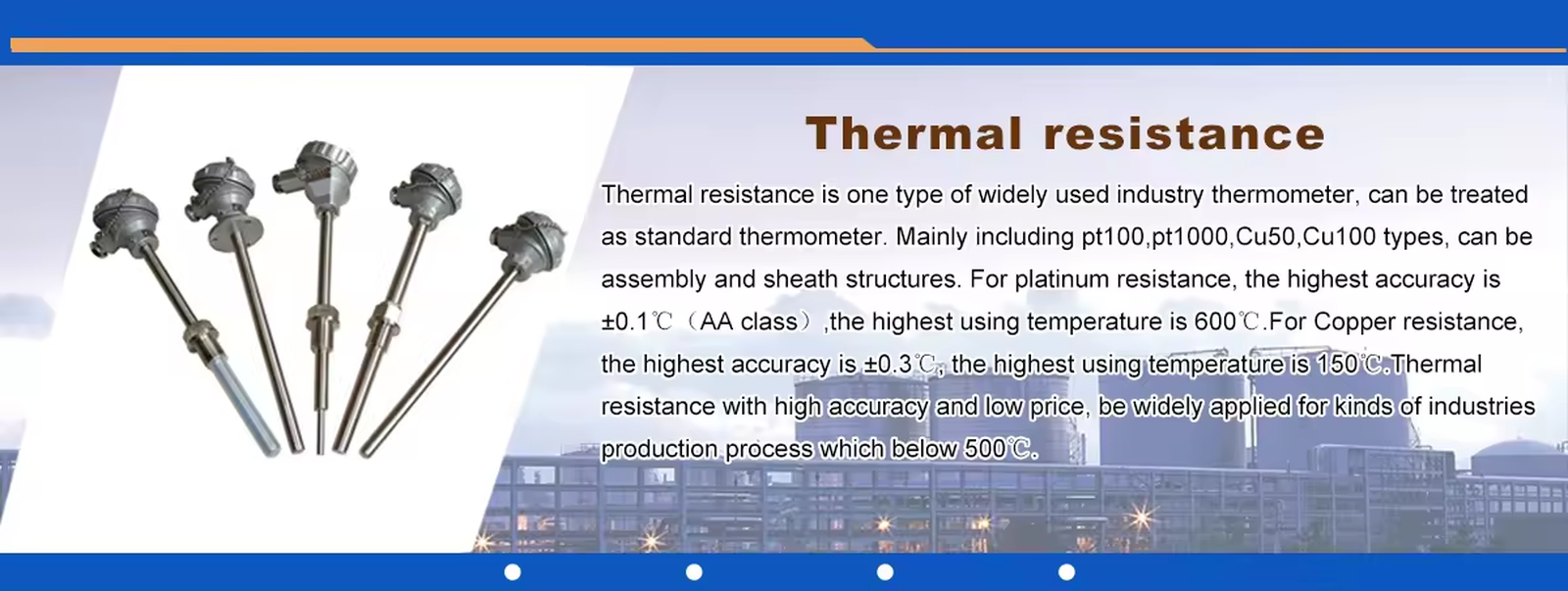
A Resistance Temperature Detector (RTD) is a device with a significant temperature coefficient (that is, its resistance varies with temperature). It is used as a temperature measurement device, usually by passing a low-level current through it and measuring the voltage drop. A thermistor is a common type of RTD.
productcate-1600-603

productcate-1600-500

What are the features of assemble rtd?


Thermoelements

● Pt100, Pt1000, Cu50, Cu100 and so on are suitable types.
● 3-wire system is regularly applied. To achieve better precision, 4-wire system is recommended.
● Single resistance wire type is the most common type, double and triple wire types are customizable according to the necessity.


Specifications

● The ways to make connections are connectors, water-proof heads, explosion-proof heads, etc. Head-mounted temperature transmitter is available for the junction enclosure.
● Installation methods: no mounting, thread mounting, and flange mounting.
● Temperature suggestion and accuracy info please refer to Thermal Resistance Limits Of Error.


Protection tube

● The outer diameter parameters are φ12,16,20 for the protection tube.
● Material: stainless steel, corrosion-resistant alloy, sleeved PTFE, etc.
● The minimum length is usually not shorter than 150mm, the maximum length usually doesn’t exceed 3000mm.


What are the features of sheath rtd?


Thermoelements

● Pt100 is the suitable type.

● 3-wire system is regularly applied. To achieve better precision, 4-wire system is recommended.

● Single resistance wire type is the most common type, double and triple wire types are customizable according to the necessity.


Specifications

● The ways to make connections are connectors, water-proof heads, explosion-proof heads, etc.  Head-mounted temperature transmitter is available for the junction enclosure.

● Installation methods: no mounting, thread mounting, and flange mounting.

● Temperature suggestion and accuracy info please refer to Thermal Resistant Limits Error Chart.


Protection tube

● The outer diameter parameters are φ3,4,5,6,6.35,8 for the protection tube.

● Our material selections are stainless steel, corrosion-resistant alloy, sleeved PTFE, etc.


Application


Photovoltaic industry
Aviation industry
Chemical industry
Equipment manufacturing industry
Metallurgical industry
University Applications


Our Certificates


productcate-800-533
Business License
productcate-800-533
Certificate of High-tech Enterprise
productcate-800-533
Certificate of “SRDI”
productcate-800-533
Director of China Instruments Manufacturers Association
productcate-800-533
Member Of China Photovoltaic Industry Association (CPIA)
productcate-800-533
Recommend Supplier Of China Heat Treatment Association(CHTA)
productcate-800-1159
Certificate of National Torch Program Items
productcate-800-1159
Certificate Of Work Safety Standardization
productcate-800-1159
Intellectual Property Management System Certification
FAQ


Q: How is RTD used to measure temperature?

A: It consists of a thin film of platinum on a plastic film. Its resistance varies with temperature and it can typically measure temperatures up to 850 °C. Passing current through an RTD generates a voltage across the RTD. By measuring this voltage, you can determine its resistance and, thus, its temperature.

Q: What is a PT100 RTD?

A: A PT100 is the most common type of Resistance Temperature Detector (RTD). The PT100 has a resistance of 100 Ohms at 0°C and 138.5 Ohms at 100°C. PT100s are a common choice for measuring temperature in industrial processes and laboratories. They are a popular choice due to their stability, accuracy and repeatability.

Q: Where is RTD used?

A: RTDs (resistance temperature device) are temperature sensors that are commonly used in a variety of industrial applications including industrial boilers, petrochemical, exhaust gas monitoring and food processing.

Q: What are RTDs used for?

A: The resistance temperature detector (RTD), is a thin film device made of platinum, which is used for measuring temperature. It has great stability, accuracy and repeatability. The resistance tends to be almost linear with temperature – the higher the temperature, the larger the resistance.

Q: Why use RTD instead of thermocouple?

A: RTD's provide the highest accuracy and may be the prefer- red solution when a temperature measurement accuracy is required to be around ± 0.05 to ± 0.1 °C. Thermocouples in comparison, have a lowered accuracy around ± 0.2 to ± 0.5 °C.

Q: Is RTD analog or digital?

A: In the past, temperature sensing was primary performed by evaluation of analog sensor components like RTDs, NTCs or thermocouples.

Q: What is the best type of RTD?

A: Platinum RTD (Pt RTD): Platinum RTDs are the most popular type of RTD and are widely used in many industrial applications. They have excellent stability, accuracy, and linearity over a wide range of temperatures. Platinum RTDs are available in two resistance values: Pt100 and Pt1000.

Q: Why is RTD important?

A: RTD sensors are used across several industries to perform the important task of temperature detection. Compared to other temperature sensing devices, RTDs have proven to be some of the most accurate in the industry. These devices are useful when accuracy and stability of measurements is essential.

Q: Why does a RTD have 3 wires?

A: A 3-wire RTD uses a third wire to measure and compensate for some of the effects of the resistance of the lead wires on the temperature measurement, especially in cases where the temperature sensor is located far from the temperature transmitter.

Q: What is RTD and its types?

A: Resistant Temperature Detector (RTD) is a type of temperature sensor, often referred to as resistance thermometers. Its works on the basis of change in resistance of metal due to change in temperature.

Q: What is the principle of RTD and thermocouple?

A: They operate on the principle that the resistivity of a metal increases in proportion to its temperature. A Platinum RTD uses platinum (Pt) for a resistance temperature sensing element, which has good temperature characteristics and is linear and stable.

Q: Can we replace RTD with thermocouple?

A: Some thermocouples look very similar to an RTD. There are, however, usually some small differences. You usually can't just replace a thermocouple with an RTD without making some changes, such as, reprogramming the controller for a different type of temperature sensor.

Q: Where is RTD sensor used?

A: RTDs (resistance temperature device) are temperature sensors that are commonly used in a variety of industrial applications including industrial boilers, petrochemical, exhaust gas monitoring and food processing.

Q: What is the difference between 2 wire and 3 wire RTD?

A: In essence: 2-Wire is simple and cost-effective but least accurate. 3-Wire is a compromise, balancing accuracy and cost. 4-Wire offers the highest accuracy, compensating for all lead wire resistances, but comes at the highest cost.

Q: What is the advantages of RTD?

A: An RTD can provide highly accurate and consistent temperature measurements because the change in resistance of certain materials is so predictable. Most RTD sensors have a response time between 0.5 to 5 seconds and commonly feature a platinum based element, but can also be constructed with nickel or copper.

Q: How many types of RTD sensors are there?

A: The most common RTD types are platinum, nickel, and copper RTDs. Platinum RTDs are the most commonly used type of RTD, followed by nickel and copper RTDs. RTDs are also available in different tolerance classes, with Class A and Class B being the most commonly used classes.

Q: Why RTD are used in industry?

A: Sometimes referred to as resistance thermometers, RTDs are commonly used in laboratory and industrial applications because they provide accurate, reliable measurements across a wide temperature range.

Q: What is an example of a RTD sensor?

A: Some of the examples of RTD sensor are coolant sensor, transmission oil temp. sensors, intake air temperature sensor, fire detectors, etc.. Due to their accuracy and stability, RTD sensors are rapidly replacing thermocouples in industrial applications. RTD can give higher accuracy values.

Q: Where is RTD used?

A: RTDs (resistance temperature device) are temperature sensors that are commonly used in a variety of industrial applications including industrial boilers, petrochemical, exhaust gas monitoring and food processing.

Q: What is the difference between Pt100 and Pt1000 RTD?

A: The main difference between Pt100s and Pt1000s in general is the electrical resistance at 0⁰C, which is the number in the name: a Pt100 is 100Ω at 0⁰C and a Pt1000 is 1000Ω at ⁰C. This makes Pt1000s more accurate for small temperature changes as they would result in larger changes in resistance when compared to Pt100s.

Q: Can RTD measure air temperature?

A: Outdoor Air Temperature RTD sensors are designed with a closed tip assembly to protect the sensing element from flowing corrosive, condensing or dusty air. The sensor measures temperatures between 5 and 80 °C.

Q: Why 4 wire RTD is used?

A: They are primarily used in laboratory applications where high accuracy is essential. This circuit is used for longer wire lengths between the measuring element and the measuring electronics as it is able compensate for errors caused by the wire resistance.


As one of the leading thermal resistance rtds manufacturers in China, we warmly welcome you to buy thermal resistance rtds made in China here from our factory. All customized products are with high quality and competitive price.

Tungsten Rhenium Thermocouple W Tube, , Main Multipoint Bf Thermocouple