


Thermocouple and RTD Wires
What is Thermocouple Compensation Wires
Thermocouples are connected to wires that are used to measure the temperature of applications like diesel engines, exhausts, and other industrial processes where temperature monitoring is critical. The thermocouple wire is connected to a sensor used for determining temperature.
Benefits of Thermocouple Compensation Wires
Wide temperature range
Thermocouples can measure temperatures from -200°C to over 2000°C, making them suitable for a wide range of applications.
Fast response time
Thermocouples have a fast response time, meaning they can quickly detect changes in temperature.
Low cost
Thermocouples are relatively inexpensive compared to other temperature sensors.
Rugged and durable
Thermocouples are rugged and durable, making them suitable for use in harsh environments.


Why Choose Us
One-stop Service
We promise to provide you with the fastest reply, the best price, the best quality, and the most complete after-sales service.
Competitive Pricing
We offer competitive pricing for our services without compromising on quality. Our prices are transparent, and we do not believe in hidden charges or fees.
Best After Service
Provide professional installation and training. Detailed operation manual and video for customer installation. Any problems will be solved within 24 hours. Broken parts will be sent to customer by air during guarantee period.
State-of-the-art Technology
We use the latest technology and tools to deliver high quality services. Our team is well-versed in the and advancements in technology and uses them to provide the best results.
Step 1: Understanding the Range of Temperature Monitoring
Start by identifying the range of temperatures that your application will need to monitor. Different types of thermocouples are designed for specific ranges of temperatures.
Make an evaluation of where the thermocouple will be used. Important factors to consider are presence of corrosive materials, level of pressure, & any dynamic forces.
Step 2: Selection of Thermocouple Variant Tailored to Thermal and Environmental Demands
In scenarios demanding the monitoring of elevated temperatures, a Type K thermocouple could be optimal, whereas Type T is better aligned with cooler temperature monitoring.
Use a chart that compares different types of thermocouples, showing their temperature handling abilities and how well they withstand various environmental conditions.
Step 3: Insulation Type Determination Predicated on Surrounding Conditions
Should the wire be subject to corrosive elements, PTFE insulation should be contemplated.
In environments of intense heat, the application of ceramic insulation is advised.
Step 4: Accuracy Necessities and Grade Determination
For applications of a general nature, standard grade wires suffice. However, for precision-critical applications, opt for wires with Special Limits of Error (SLE).
Step 5: Wire Length Calculation
Measure the span between the thermal probe and the instrument that records temperature.
Account for potential signal degradation due to extended wire length and the presence of electromagnetic disturbances. Shielded wiring may be requisite in such instances.
Step 6: Engage with Wire Specialists
Initiate dialogue with wire specialists, providing them with your detailed requirements to garner tailored advice or to commission bespoke thermocouple wiring solutions.
Step 7: Assessment and Acquisition
With a complete set of data at your disposal, meticulously evaluate your options to confirm they align with your operational criteria.
Type K Thermocouple Wire
Type K is one of the most popular types of thermocouple. It consists of a positive Nickel/Chromium alloy leg and a negative Nickel/Aluminium leg. It can be used across a wide temperature range (from -200°C to 1250°C), making it suitable for many applications in a variety of industries. It is a much more affordable option than the Platinum based Type R and Type S thermocouples which can be used at higher temperatures.
Type J Thermocouple Wire
Type J is another common type, made from a positive Pure Iron leg, and a negative Constantan (Copper/ Nickel alloy) leg. It has a smaller temperature range than type K – ranging from 0°C to 750°C but the materials in the conductors make it very cost effective. The Iron positive leg makes it very susceptible to moisture, but it is used extensively in indoor, dry applications.

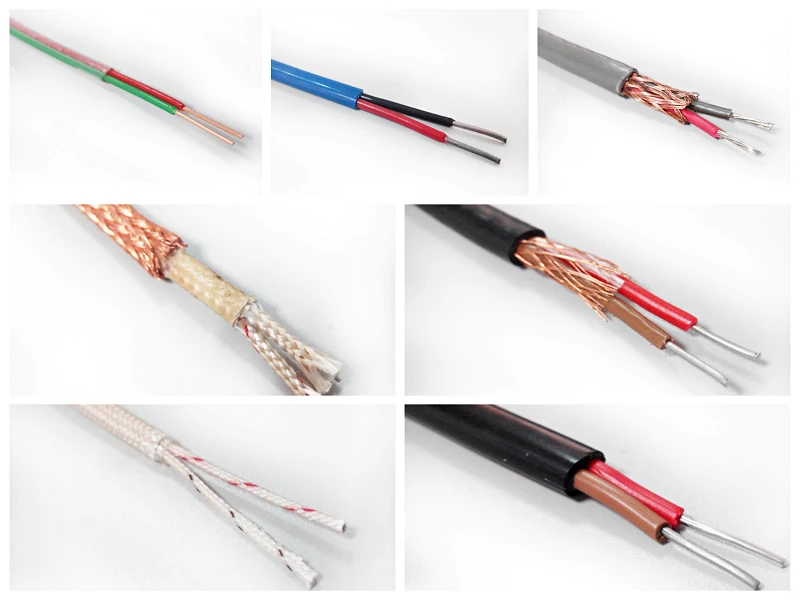
Type T Thermocouple Wire
With a positive Pure Copper leg, and negative Constantan leg, type T can be used in temperatures from -250°C to 350°C. Due to its capabilities in cold conditions, type T may be used to measure temperature in freezers. It is also one of the most accurate thermocouple combinations, making it popular in circumstances where a close control of temperature is required.
Type E Thermocouple Wire
Type E consists of a positive Nickel/Chromium leg and a negative Constantan leg. Type E has a temperature range of -200°C to 900°C, and is particularly sensitive to measuring temperatures as it has the highest voltage output per °C.
Type N Thermocouple Wire
Type N is a relatively new thermocouple combination having been created in the 1960s. It is an improvement on the popular Type K due to its superior repeatability characteristics around 400°C. Type N consists of a positive Nicrosil (Nickel/Chromium/Silicon) leg and a negative Nisil (Nickel/Silicon) leg. The addition of the specific quantities of Silicon reduces the “ageing” effect at 400°C which adversely affects Type K . It can be used at temperatures from -270°C to 1300°C. Type N may be used for measuring engine exhausts, among other applications.
What Is The Maximum Length Of Thermocouple Wire
There are many factors that can impact the usable length of a thermocouple. As a guideline, under 100 feet with 20 AWG or thicker wire in an area free of electromagnetic interference usually is fine. Two of the main factors in determining useable thermocouple length are total loop resistance and preventing electrical noise getting into the signal. Because different thermocouple wires are made of different materials, the resistance will vary based on the type as well as the wire diameter and length.
The allowable loop resistance is affected by the input resistance of the amplifier circuit to which it is attached. But as a guideline, typically the objective is to keep the total loop resistance under 100 ohms. Loop resistance is determined by multiplying the length in feet by the resistance per double feet (remember 1 foot length of run includes 1 foot from each of the two t/c wires) as shown in "Resistance Vs Wire Diameter" table for thermocouple type and gauge.
In your calculations to include the probe (when used/applicable) in addition to the wire length. The second major factor in running a thermocouple wire is to keep it away from any electromagnetic fields. Thermocouple wire creates a low voltage signal and should not be run near power wires, motors, etc. To help minimize noise pickup, a metal over braid or twisted shielded wire is commonly used.
How to identify a thermocouple by wire color
There are many types of thermocouples, each with its own unique characteristics. You can easily identify a thermocouple type by the colors of its wire insulation.In color coding, the red wire of a thermocouple is negative, and the positive wire is color coded to the type of thermocouple.
There are many types of thermocouples, each with its own unique characteristics.
You can easily identify a thermocouple type by the colors of its wire insulation.
In ANSI color coding, the red wire of a thermocouple is negative, and the positive wire is color coded to the type of thermocouple.
A type K thermocouple has one red wire and one yellow wire. Type K thermocouples have a useful temperature range of negative 200 to 1,250 degrees Celsius.
A type J thermocouple has one red wire and one white wire. Type J thermocouples have a useful temperature range of 0 to 750 degrees Celsius.
A type T thermocouple has one red wire and one blue wire. Type T thermocouples have a useful temperature range of negative 200 to 350 degrees Celsius.
A type N thermocouple has one red wire and one orange wire. Type N thermocouples have a useful temperature range of negative 270 to 1,300 degrees Celsius.
A type E thermocouple has one red wire and one purple wire. Type E thermocouples have a temperature range of negative 200 to 900 degrees Celsius.

Can Thermocouple Wire be Used at All Temperatures
| Type | Positive Conductor | Negative | Temperature | Environment/Uses |
| Conductor | Range | |||
| K | Chromel | Alumel | -200°C to 1250°C | · Vacuum*, oxidizing, inert, or reducing* |
| (90% nickel-10% chromium) | (95% nickel, 2% manganese, 2% aluminum, 1% silicon) | · General-purpose | ||
| · Testing temperatures during production processes at plants, refineries, etc. | ||||
| · Testing heat appliance safety | ||||
| J | Iron | Constantan | 0 to 750 °C | · Vacuum, oxidizing* inert or reducing |
| (45% nickel-55% copper) | · General-purpose | |||
| · Manufacturing of plastics and resin | ||||
| N | Nicrosil | Nisil | 0 to 1250°C | · Vacuum*, oxidizing, inert, or reducing* |
| (84.6% nickel, 14.2% chromium, 1.4% silicon) | (95.5% nickel, 4.4% silicon, 0.1% magnesium) | · General-purpose can be used in applications where Type K stability suffers from high temps, oxidation, and green rot | ||
| · Thermal profiling in ovens and furnaces | ||||
| · Temperature measurement of gas turbines and engine exhausts | ||||
| · Testing temperatures during production/smelting process in the metals industry | ||||
| T | Copper | Constantan | -200°C to 350°C | · Vacuum, mild oxidizing, inert, or reducing. |
| (45% nickel-55% copper) | · Good where moisture is present. | |||
| · Monitoring in food processing | ||||
| · Cryogenic applications | ||||
| E | Chromel | Constantan | -200°C to 900°C | · Vacuum*, oxidizing, inert, or reducing* |
| (90% nickel-10% chromium) | (45% nickel-55% copper) | · High sensitivity | ||
| S | Platinum-Rhodium | Platinum | 0 to 1450°C | · Inert or oxidizing |
| (87% platinum-13% rhodium) | · High temp applications | |||
| · Lab use | ||||
| · Used in BioTech and Pharmaceutical industries | ||||
| R | Platinum-Rhodium | Platinum | 0 to 1450°C | · Inert or oxidizing |
| (90% platinum-10% rhodium) | · High temp applications | |||
| · Industry use | ||||
| B | Platinum-Rhodium | Platinum-Rhodium | 870 to 1700°C | · Inert or oxidizing |
| (70% platinum-30% rhodium) | (94% platinum-6% rhodium) | · Extremely high temp applications | ||
| · Used in the glass industry | ||||
| C | Tungsten-Rhenium | Tungsten-Rhemium | 0 to 2300°C | · Vacuum, inert or hydrogen |
| (95% tungsten-5% rhenium) | (74% tungsten-26% rhenium) | · Extremely high temp applications |
How Does A Thermocouple Wire Work
A thermocouple consists of two dissimilar metal wires coming together to create a temperature measurement junction. Heating the connection point of both metals creates a thermoelectric current known as a Seebeck current. As the heat transfers from the hot end to the cooler end, the electrons within the metals create electricity.
For a thermocouple to function correctly, one metal must be positively charged and the other negatively charged. would be positively charged copper on one wire and negatively charged nickel on the other.
Thermoelectric currents are minuscule, typically measuring in microvolts. That voltage then gets translated into temperature readings. Thermocouple readouts can be quite precise, which is why these devices hold value in so many unique applications.
A Guide To Thermocouple Wire Parts
Exposed Junction
Nothing Protects The Wire Ends, Meaning That They Can Rust Or Get Damaged Over Time.
Grounded Junction
A Metal Sheath Covers The Wires (Usually Stainless Steel). This Design Is Much More Stable And Long-Lasting.
Ungrounded Junction
In This Case, The Sheath Is Not Connected Electrically To The Wires. An Ungrounded Junction Is Less Susceptible To Electromagnetic Interference.
Our Factory
The company is a "New Third Board" listed enterprise, an certified high-tech enterprise, a project undertaking organization of the National Torch Program, a certified enterprise technology center of Chongqing, a 'Specialized, Refined, Differential and Innovative(SRDI)' enterprise, a contract-abiding and trustworthy enterprise, a heat treatment industry technological innovative enterprise, one of the top 10 private scientific and technological innovation enterprises of Beibei District, Class-A tax-paying enterprise, and an Honest Beibei Merchant. Our trademark was assessed as a Famous Trademark of Chongqing.


Certifications


FAQ
Q: What is Thermocouple Wire?
Thermocouple wire also helps to maintain the electrical continuity between the thermocouple and the measurement device, which is essential for accurate temperature measurement.
Q: What are the Applications of Thermocouple Wire?
Thermocouple wire can measure temperatures ranging from -200°C to +2,300°C, depending on the type of thermocouple used. This makes it ideal for use in diverse industrial environments where temperature monitoring is critical.
Q: What are the Types of Thermocouple Wire?
Type J thermocouple wire is designed for use in lower temperature ranges of up to 750°C, while Type K thermocouple wire is suitable for use in higher temperature ranges of up to 1,260°C. Type T thermocouple wire is used in cryogenic applications, with temperature ranges from -200°C to +350°C.
Type E thermocouple wire is suitable for use in high-temperature applications up to 1,000°C, while Type N thermocouple wire is used in applications requiring accuracy and stability at high temperatures of up to 1,300°C.
Type S thermocouple wire is used in high-temperature applications of up to 1,600°C, where resistance to oxidation is important.
Q: How is Thermocouple Wire Installed?
For some applications, it may be necessary to use a cable gland to ensure a secure and sealed connection between the thermocouple wire and the measurement device.
Q: What makes thermocouple wire types different?
Q: What is the difference between thermocouple wire cable and extension grade wire?
Extension grade wire is used to extend from the thermocouple probe to the control system or digital display. Extension grade wire is more economical due to lesser grade alloys being used. Extension grade wire is also not generally within the process and does not play as critical of a role as the thermocouple grade wire. It also does not experience the temperature extremes and cycling of the sensor itself.
In many industrial applications, a sensor is located in a process pipe far away from the control room. This means that wire must be run a considerable distance back to the control room to get the temperature reading. Using more expensive thermocouple grade wire to accomplish this is unnecessary. Extension grade wire will do the job.
Q: What do thermocouple wire colors indicate?
Q: What are Special Limits of Error (SLE)?
Special Limits of Error: These thermocouples are made with a higher grade of thermocouple wire that is purer than standard wire, which increases their accuracy. They are more expensive than standard thermocouples.
Q: Do thermocouple wires need to be the same length?
Q: How far can you run thermocouple wire?
Practically speaking, the longest you want to go with a standard thermocouple run is about 100 feet without having to start jumping through hoops to get an accurate, low noise measurement. Even in this case, you will probably want to use shielded, SLE wire at least 18 gauge or larger.
Q: Is it OK to splice thermocouple wire?
Q: What happens if you wire a thermocouple backwards?
Q: Can you extend thermocouple wire with regular wire?
Q: What is positive and negative on thermocouple wire?
Q: Can you twist thermocouple wires together?
Q: Can I use copper wire to extend a thermocouple?
Q: Can you crimp thermocouple wire?
Q: What will happen if thermocouple wires get shorted?
Q: Can thermocouple wires touch each other?
Q: How do you fix a broken thermocouple wire?
As one of the leading thermocouple and rtd wires manufacturers in China, we warmly welcome you to buy thermocouple and rtd wires made in China here from our factory. All customized products are with high quality and competitive price.