


Armored Thermocouples
What is Armored Thermocouples
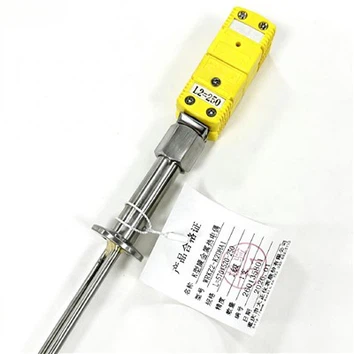
Armored thermocouples feature a heavy duty stainless steel armor over the thermocouple wire. The armor protects the wire from mechanical damage. Armored thermocouples are well suited for industrial environments where an unprotected thermocouple may be cut or broken.
Resistant To Vibration And Shock
The metal sheath and the MI cable protect the conductors from shock and vibration, preventing breakage and making sheathed thermocouples highly resistant to mechanical stresses.
Resistant To Corrosion And Aggressive Media
316 stainless steel has good resistance against aggressive media and the vapor and flue gases in chemical media. The corrosion-resistant properties of Alloy 600 make it particularly well suited for thermocouples that have to deal with high temperatures. It also withstands cracking and pitting in media that contains chlorine, and corrosion produced by hydrogen chloride or ammonia in aqueous solutions.
Small And Flexible
The protective metal sheath allows for finer conductors and a more compact design than those of unsheathed thermocouples. Sheathed thermocouples' diameter can be as small as 0.25 mm (0.010″) without compromising the integrity of the instrument. The metal sheath also gives flexibility, which allows bending without damaging the sensing element.sheathed thermocouples are particularly useful for temperature measurement in small spaces and in tight corners.
Conductivity And High Temperature Limits
The metal sheath tolerates very high air temperatures: Up to 850°C (1,562°F) for 316 stainless steel, and up to 1,200°C (2,192°F) for Alloy 600 – depending on thermocouple type. The sheath also provides better heat conduction than unsheathed thermocouples, thereby decreasing thermal lag time and resulting in even faster responses.




Why Choose Us
One-stop Service
We promise to provide you with the fastest reply, the best price, the best quality, and the most complete after-sales service.
Competitive Pricing
We offer competitive pricing for our services without compromising on quality. Our prices are transparent, and we do not believe in hidden charges or fees.
Best After Service
Provide professional installation and training. Detailed operation manual and video for customer installation. Any problems will be solved within 24 hours. Broken parts will be sent to customer by air during guarantee period.
State-of-the-art Technology
We use the latest technology and tools to deliver high quality services. Our team is well-versed in the and advancements in technology and uses them to provide the best results.
The Armoured Thermocouple market is experiencing steady growth due to the increasing demand for temperature measurement solutions in various industries such as petrochemical, automotive, aerospace, and pharmaceuticals. Armoured thermocouples are widely used in applications where high temperatures, corrosive environments, or high vibration levels are present.
One of the key market trends driving the growth of the armoured thermocouple market is the increasing focus on industrial automation and process control. Armoured thermocouples are essential for maintaining consistent and accurate temperature readings in automated systems, ensuring optimal performance and efficiency.
Another trend driving the growth of the market is the increasing adoption of advanced materials and technologies in thermocouple manufacturing. Manufacturers are constantly innovating to develop thermocouples that can withstand harsh environments and deliver reliable performance.
The market is also seeing growth opportunities in emerging economies where industries are rapidly expanding and modernizing their operations. Developing countries such as China, India, and Brazil are major contributors to the growth of the armoured thermocouple market as they invest in infrastructure development and industrialization.
The armoured thermocouple market is poised for significant growth in the coming years, driven by the increasing demand for temperature measurement solutions in various industries, the focus on industrial automation, and the growing adoption of advanced materials and technologies. Manufacturers in the market are expected to capitalize on these trends and opportunities to expand their market presence and increase their revenue.


Steel and iron industries
Thermocouples are used to monitor the temperature and chemistry of molten metal during various stages of the steel-making process. Types B, S, R, and K thermocouples are commonly used in electric arc furnaces, ladles, tundishes, molds, and rollers.
Gas appliances
Thermocouples are used to detect the presence of a pilot flame in gas heaters, boilers, ovens, stoves, and fireplaces. If the pilot flame goes out, the thermocouple shuts off the gas supply to prevent gas leakage or explosion.
Thermopile radiation sensors
Thermopiles are arrays of thermocouples connected in series that measure the intensity of incident radiation (especially visible and infrared light). They are used in devices such as pyrometers, radiometers, spectrometers, thermal cameras, and solar panels.
Manufacturing
Thermocouples are used to measure and control the temperature of various processes and products in manufacturing industries such as food processing, chemical processing, pharmaceutical, aerospace, automotive, and biomedical industries. Types K, J, T, E, and N thermocouples are commonly used to measure and control the temperature of various processes and products in these industries.
Power production
Thermocouples are used to measure and monitor the temperature of various components and systems in power plants, such as boilers, turbines, generators, transformers, reactors, and fuel cells. Types R, S, B, K, and N thermocouples are commonly used in power production applications.
Process plants
Thermocouples are used to measure and control the temperature of various fluids and gases in process plants, such as oil refineries, petrochemical plants, gas pipelines, and water treatment plants. Types K, J, T, E, and N thermocouples are commonly used in process plant applications.
Thermocouples as vacuum gauge
Thermocouples can be used to measure the pressure of a vacuum by measuring the temperature difference between a heated wire and an unheated wire in a thermocouple circuit. The pressure of the vacuum is inversely proportional to the temperature difference. This type of vacuum gauge is known as a thermocouple gauge or a Pirani gauge.
The thermocouple consists of a combination of two materials with diameters ranging from 0.2 to 5 mm. When using noble materials such as rhodium or platinum, these dimensions range from 0.1 to 0.5 mm. When selecting a thermocouple material, care should be taken to ensure that it has a high Seebeck factor and that temperature affects its value as little as possible in order to achieve a linear characteristic. The appropriate thermocouple material is selected according to the range of the measured temperature.
The probe's casing is exposed to very high temperatures,it is necessary to use different types of steel. At the highest temperatures, the thermocouple protection tube is made of heat-resistant steel or ceramic materials. The thermowell must be resistant to corrosion, thermal shock and mechanical damage. A desirable feature to prevent corrosion of the thermocouple is the impermeability of gases that could significantly accelerate the aging process of the thermocouple. There are also designs without a cover that are used to reduce dynamic errors. For special measurements, such as the temperature of liquid metals, glass or liquid steel, highly specialized thermocouple designs are used.

Fixed-point calibration: Fixed-point calibration for thermocouples involves comparing the output of the thermocouple to a reference temperature from a stable, well-defined source. This can include ice-point cells, triple-point cells, or other high-precision temperature sources. The thermocouple is placed in the reference source, and its output is measured and compared to the known temperature. Fixed-point calibration is a typical thermocouple calibration method. The temperature of a reference point is precisely measured with a calibrated thermometer in this procedure, and the output voltage of the thermocouple at that temperature is then recorded. This process is performed at various reference temperatures to generate a calibration table that can be used to compute the thermocouple's temperature based on its output voltage.
Comparison calibration: In this method, the thermocouple's output is compared to that of a reference sensor, such as a high-precision platinum resistance thermometer or another calibrated thermocouple. Both sensors are exposed to the same temperature source, and their readings are compared. Any deviations from the reference sensor's output can be used to determine the necessary adjustments or corrections to the thermocouple's measurements. The calibration of thermocouples is required to guarantee that temperature measurements are precise and dependable. There are various thermocouple calibration methods available, each having advantages and downsides.
Electrical simulation: Electrical simulation for thermocouples involves using a calibrated voltage source or a thermocouple simulator to generate a known voltage that corresponds to a specific temperature. The thermocouple's output is compared to the simulated voltage, and any discrepancies can be used to make adjustments to the thermocouple's measurements. Another approach for thermocouple calibration is electrical simulation. An electrical circuit is used to replicate the thermoelectric behaviour of the thermocouple being calibrated in this procedure. The circuit is intended to provide a voltage output that resembles the voltage output of a thermocouple across a wide temperature range. To obtain a calibration curve, the voltage output is measured and compared to the voltage output of the thermocouple being calibrated.
Software-based calibration: Some advanced thermocouple instruments provide software-based calibration methods that can automatically adjust the thermocouple's output based on pre-determined calibration data. This approach may involve storing calibration coefficients or correction factors within the instrument's software, which can be applied to the thermocouple's output during measurements.
Thermocouple Maintenance
Periodic Calibration: Due to their potential for drift and degradation, thermocouples require more frequent calibration than RTDs. Establish a calibration schedule based on the application's requirements and the thermocouple's stability. Regular calibration ensures accurate temperature measurements and helps identify issues early.
Visual Inspection: Inspect thermocouples regularly for signs of wear, corrosion, or contamination. Check the connections, cables, and mounting hardware for any signs of damage or loosening. Promptly address any issues to prevent sensor failure and maintain accurate measurements. Visual examination is an important element of thermocouple maintenance since it entails inspecting the thermocouple and its accompanying components for signs of wear, corrosion, or deterioration.
Cleaning: Keep the thermocouple sensor clean and free from contaminants that could affect its performance. Use appropriate cleaning methods and materials based on the sensor's construction and the type of contaminants present. Cleaning is an important part of thermocouple maintenance because it removes any impurities or debris that may impact the accuracy or dependability of the thermocouple measurement.
Replacement: Thermocouples have a limited and may need to be replaced periodically. Monitor their performance and replace them when their accuracy falls outside the acceptable range or if they show signs of significant wear or damage. Replacement of the thermocouple is a key step in thermocouple maintenance that must be done with care. Thermocouples may need to be changed for a variety of reasons, including damage to the wires or connections, wear and tear over time, or a change in the temperature range needed by the application.
Documentation: Maintain records of calibration, inspection, and maintenance activities for each thermocouple. This documentation can help track the sensor's performance over time and identify trends or potential issues. The need for documentation in thermocouple maintenance cannot be overstated. Proper documentation ensures that the thermocouple system is properly maintained, aids in troubleshooting, and serves as a record of maintenance history. Documentation contains information such as thermocouple type, gauge, and insulation, as well as thermocouple location, installation date, calibration dates and results, and any maintenance conducted.
Our Factory
The company is a "New Third Board" listed enterprise, an certified high-tech enterprise, a project undertaking organization of the National Torch Program, a certified enterprise technology center of Chongqing, a 'Specialized, Refined, Differential and Innovative(SRDI)' enterprise, a contract-abiding and trustworthy enterprise, a heat treatment industry technological innovative enterprise, one of the top 10 private scientific and technological innovation enterprises of Beibei District, Class-A tax-paying enterprise, and an Honest Beibei Merchant. Our trademark was assessed as a Famous Trademark of Chongqing.


Certifications


FAQ
Q: What is the difference between a thermocouple and a thermometer?
Q: Is a thermocouple AC or DC?
Q: How do I choose a thermocouple type?
- Temperature range
- Chemical resistance of the thermocouple or sheath material
- Abrasion and vibration resistance
- Installation requirements (may need to be compatible with existing equipment; existing holes may determine probe diameter)
Q: What is the response time of a thermocouple?
Q: What are the accuracies and temperature ranges of the various thermocouples?
Q: Can I use any multimeter for measuring temperature with thermocouples?
Q: What is a thermocouple?
Thermocouples are manufactured in a variety of styles, such as thermocouple probes, thermocouple probes with connectors, transition joint thermocouple probes, infrared thermocouples, bare wire thermocouple or even just thermocouple wire.
Thermocouples are commonly used in a wide range of applications. Due to their wide range of models and technical specifications, but it is extremely important to understand its basic structure, functionality, ranges as to better determine the right thermocouple type and material of thermocouple for an application.
Q: How does a thermocouple work?
If this circuit is broken at the center, the net open circuit voltage (the Seebeck voltage) is a function of the junction temperature and the composition of the two metals. Which means that when the junction of the two metals is heated or cooled a voltage is produced that can be correlated back to the temperature.
Q: Thermocouple probes vs. Thermocouple wire?
Each calibration has a different temperature range and environment, although the maximum temperature varies with the diameter of the wire used in the thermocouple.
Although thermocouple calibration dictates the temperature range, the maximum range is also limited by the the diameter of the thermocouple wire. That is, a very thin thermocouple may not reach the full temperature range.
K Type Thermocouples are known as general purpose thermocouple due to its low cost and temperature range.
Q: How do I choose a thermocouple?
The most commonly criteria used to make that choice are the temperature range, the chemical resistance, the abrasion and vibration resistance and the installation requirements. Installation requirements would also dictate your choice of a thermocouple probe.
There are different types of thermocouples and their applications may vary. An exposed thermocouple will work best when high response times are required, but an ungrounded thermocouple is better in corrosive environments.
Q: How do I know which junction type to choose?
Q: What are the accuracies and temperature ranges of the various thermocouples?
Q: Thermocouple probes vs. Thermocouple wire?
Using a wire style sensor may be fine if the fluid does not attack the insulation or conductor materials, if the fluid is at rest or nearly so, and the temperature is within the capability of the materials. But say that the fluid is corrosive, high temperature, under high pressure or flowing through a pipe, then a probe style sensor, maybe even with a thermowell, will be a better selection.
It all comes down to how best get the thermocouple junction to the same temperature as the process or material you are trying to measure the temperature of, so to get the information you need.
Q: Which is more accurate thermometer or thermocouple?
Q: How many volts does a thermocouple put out?
This small value of voltage, usually around 25 – 30 DC millivolts, provides the power to hold the pilot light valve open during normal operation. The types of metals used in the construction of the thermocouple depend upon the values of temperature they are to be subjected to.
Q: What is the most reliable thermocouple?
Q: What is the best thermocouple for high temperature?
Q: How do you know if you have a bad thermocouple?
Q: How do you test a thermocouple with a magnet?
Q: What happens if a thermocouple fails?
As one of the leading armored thermocouples manufacturers in China, we warmly welcome you to buy armored thermocouples made in China here from our factory. All customized products are with high quality and competitive price.