


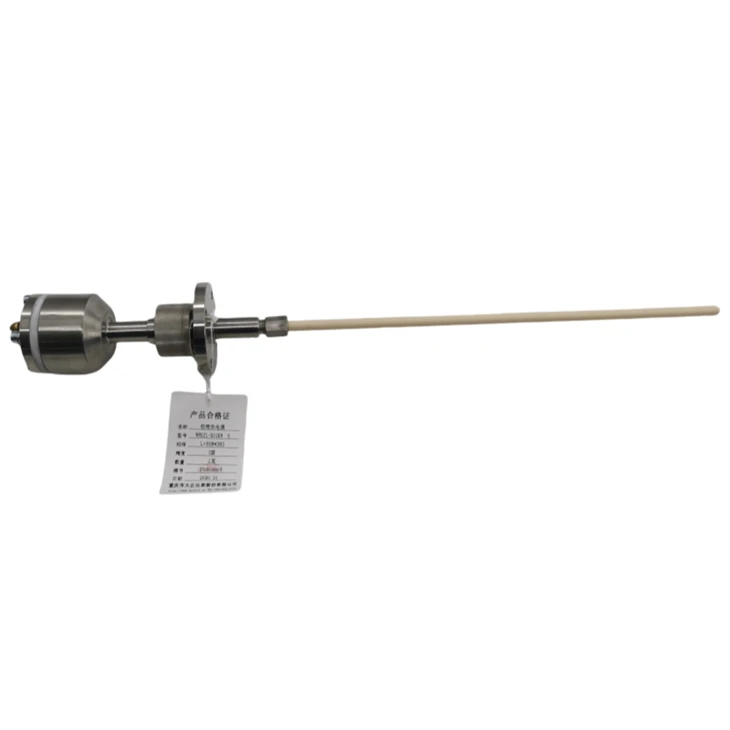


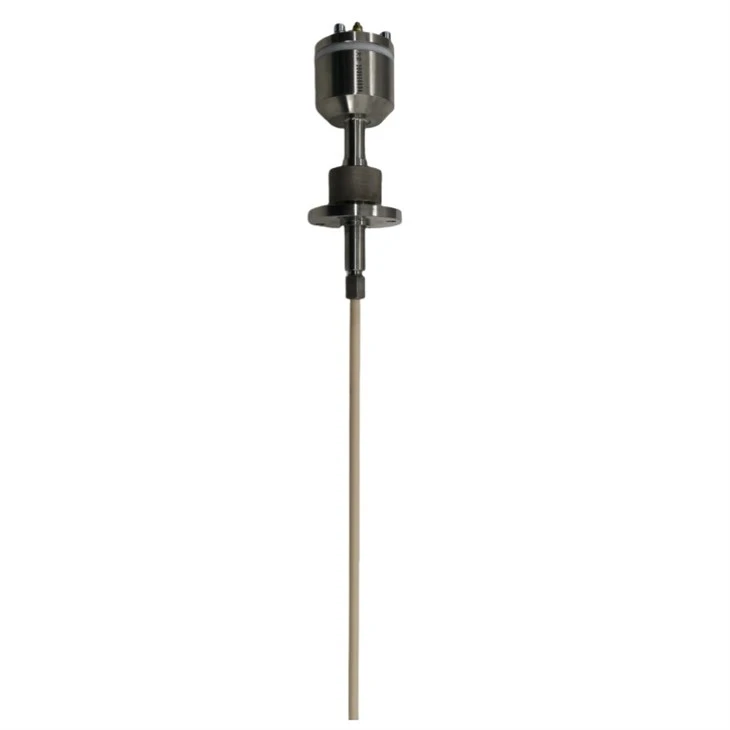

Features
I. Core Parameters
|
Parameter Category |
Specific Specifications / Parameter Values |
|
Model Type |
Type S, Type R, Type B |
|
Thermoelectric Element Material |
Type S: Platinum-Rhodium 10 - Platinum (PtRh10-Pt); Type R: Platinum-Rhodium 13 - Platinum (PtRh13-Pt); Type B: Platinum-Rhodium 30 - Platinum-Rhodium 6 (PtRh30-PtRh6) |
|
Operating Temperature Range |
Type S/Type R: 0~1600℃; Type B: 600~1700℃ |
|
Measurement Accuracy |
Type S/Type R (Class 1): ±1.0℃ at 600~1100℃, ±[1+0.003(t-1100)]℃ at 1100~1600℃; Type S/Type R (Class 2): ±1.5℃ or ±0.25%t (whichever is larger) at 0~1600℃; Type B (Class 2): ±1.5℃ or ±0.25%t (whichever is larger) at 600~1700℃; Type B (Class 3): ±4.0℃ or ±0.5%t (whichever is larger) at 600~1700℃ |
|
Protection Tube Material |
99% Alumina (Al₂O₃) |
|
Protection Tube Diameter |
Standard 8mm, other outer diameters customizable |
|
Length Specification |
Total length and insertion length shall be specified (customizable) |
|
Connection Method |
Waterproof Connector |
|
Structural Characteristics |
Special vacuum-sealed structure, assembled design |
|
Applicable Environment |
Oxidizing atmosphere, high-temperature vacuum environment (special sealed design isolates external interference) |
Vacuum-sealed Platinum rhodium thermocouple Conductor Combinations And Characteristics
|
Type |
Thermoelement |
Temperature range ℃ |
Function Features |
|
|
Advantages |
Disadvantages |
|||
|
S |
Ptrh10-Pt |
0~1600 |
Suitable for oxidation atmosphere. High precision, stability is not affected by using time.With oxidation resistance, chemical corrosion resistance, can be used as standard thermocouple. |
Not suitable for reducing atmosphere (especially H2, metal vapor) and vacuum environment, high cost. |
|
R |
Ptrh13-Pt |
0~1600 |
||
|
B |
Ptrh30-Ptrh6 |
600~1700 |
Suitable for more than 1000℃,with small thermoelectric, oxidation resistance and chemical corrosion resistance |
Can't be used below 600℃, low sensitivity. |
Vacuum-sealed Platinum rhodium thermocouple Limit Of Error
|
|
Thermoelement |
Type |
Limits Of Error(±℃)/Effective Temperature Range(℃) |
||
|
1 class |
2 class |
3 class |
|||
|
Nobel Metal TC |
Ptrh10-Pt |
S |
1.0/600~1100 1+0.003(t-1100)/1100~1600 |
1.5 or 0.25%t/0~1600 |
-- |
|
Ptrh13-Pt |
R |
||||
|
Ptrh30-Ptrh6 |
B |
-- |
1.5 or 0.25%t/600~1700 |
4.0 or 0.5%t/600~1700 |
|
II. Product Features
Exclusive Vacuum-Sealed Design: Adopts a special vacuum-sealed structure, which can effectively isolate external environmental interference, avoid temperature measurement data distortion under high-temperature vacuum working conditions, and ensure measurement reliability in extreme environments.
High Upper Limit of High-Temperature Measurement: Covers a wide temperature range of 0~1700℃, among which Type B has a maximum temperature resistance of 1700℃, and Type S/Type R reach 1600℃, adapting to the precise temperature measurement needs of ultra-high temperature scenarios.
Excellent Measurement Accuracy: The Class 1 accuracy reaches up to ±1.0℃, with stable thermoelectric performance. It can be used as a standard thermocouple with strong data traceability.
Strong Environmental Adaptability: Type S/Type R/Type B are all suitable for oxidizing atmospheres, with excellent oxidation resistance and chemical corrosion resistance, which can resist the erosion of harsh media at high temperatures.
Flexible Structural Assembly: Adopts an assembled structure, the length and diameter of the protection tube can be customized, and the waterproof connector connection method adapts to the installation needs of different equipment, with strong compatibility.
III. Related Component Specifications
1. Core Temperature Measurement Components
Thermoelectric Elements: Type S (PtRh10-Pt), Type R (PtRh13-Pt), Type B (PtRh30-PtRh6) are made of precious metals, with stable thermoelectric potential and little performance attenuation at high temperatures.
Accuracy Class: Supports Class 1, Class 2, and Class 3 (exclusive to Type B) accuracy options, meeting the accuracy requirements of different scenarios.
2. Protection Tube Components
Material: 99% Alumina (Al₂O₃), with high temperature resistance, corrosion resistance, and high mechanical strength, suitable for high-temperature environments below 1700℃.
Dimensions: Standard diameter 8mm, total length and insertion length can be customized on demand to adapt to the installation depth of different furnaces.
3. Connection and Sealing Components
Connection Connector: Waterproof connector design with excellent sealing performance, preventing moisture and impurities from entering the interior and affecting performance.
Vacuum-Sealed Structure: Special sealing components ensure no leakage in vacuum environment, guaranteeing temperature measurement stability and equipment safety.
IV. Application Scenarios
Specially designed for high-temperature vacuum and oxidizing environments, this product is mainly applied in the following scenarios:
High-Temperature Vacuum Furnace Measurement: Temperature monitoring of equipment such as vacuum sintering furnaces and vacuum melting furnaces, adapting to the vacuum high-temperature processing technology of high-end materials such as aerospace materials and special alloys.
High-Temperature Furnace in Oxidizing Atmosphere: Temperature control of various high-temperature kilns and bright annealing furnaces, adapting to the high-temperature oxidation treatment process of materials such as metals and ceramics.
Standard Temperature Measurement Reference: Due to its high accuracy and strong stability, it can be used as a standard thermocouple in laboratories or industrial sites to calibrate other temperature measurement equipment.
High-End Manufacturing Field: Temperature control and monitoring of ultra-high temperature heat treatment processes in high-end manufacturing such as aerospace, electronic components, and special materials, such as temperature measurement of high-temperature processing of turbine blades and semiconductor materials.
Scientific Research Experiment Scenarios: Ultra-high temperature physical experiments and material high-temperature resistance performance tests in universities and research institutions, providing accurate support for experimental data collection.
V. Product Advantages
Extreme Environment Adaptability: The combination of vacuum-sealed structure and precious metal thermoelectric elements perfectly adapts to high-temperature vacuum and oxidizing environments, filling the application gap of ordinary thermocouples in extreme working conditions.
Leading High-Temperature Performance: The maximum temperature resistance reaches 1700℃, far exceeding ordinary metal thermocouples. Moreover, the accuracy is stable at high temperatures without obvious drift, and the service life is long.
Complete Accuracy Classes: From standard Class 1 to general Class 3, it can be flexibly selected according to scenarios, balancing the needs of high-precision measurement and cost control.
Flexible Structural Customization: The size and insertion length of the protection tube can be customized, and the waterproof connector connection adapts to various equipment, making installation and maintenance convenient.
Reliable Quality Assurance: The manufacturer has mature precious metal thermocouple manufacturing technology. The products have undergone strict tests such as vacuum leak detection and high-temperature calibration, serving many well-known enterprises and scientific research institutions.
VI. Frequently Asked Questions (FAQs)
How to select Type S, Type R, and Type B?
Answer: For conventional high-temperature oxidizing scenarios (0~1600℃), Type S is selected for its balanced accuracy and cost-effectiveness; Type R is optional for scenarios with higher accuracy requirements; Type B is selected for ultra-high temperature scenarios above 1000℃ (600~1700℃), but it should be noted that Type B has low sensitivity below 600℃ and is not suitable for low-temperature measurement.
Why is the product not suitable for reducing atmosphere?
Answer: The precious metal materials of Type S/Type R/Type B platinum-rhodium thermocouples are prone to chemical reactions in reducing atmospheres (especially hydrogen and metal vapor environments), leading to thermoelectric potential drift and component damage, which affects measurement accuracy and service life. It is only suitable for oxidizing or vacuum environments.
Does the vacuum-sealed structure require regular maintenance?
Answer: Yes. It is recommended to check the integrity of the sealing components every 6~12 months to avoid vacuum leakage caused by sealing aging; when used at high temperatures above 1500℃ for a long time, the maintenance cycle can be shortened to 3~6 months to ensure stable sealing performance.
What is the recommended calibration cycle for the product?
Answer: Annual calibration is recommended. When used under ultra-high temperature (above 1300℃) or frequent start-stop working conditions for a long time, calibration every 6 months is recommended to avoid accuracy degradation caused by component aging.
Can the protection tube be replaced?
Answer: Yes. The product adopts an assembled structure, and the protection tube can be replaced individually after damage, without replacing the entire thermocouple, which reduces the use and maintenance costs; when replacing, a 99% alumina protection tube of the same material and specification should be selected to ensure consistent temperature measurement performance.
Shock-resistant packaging


Our Customers

Insights into our company


Insights into our production

Manual Welding

Automatic Welding

Insulation Testing

Laser Marking

Warehouse Managing

Thermocouple Assemble

Vacuum Leak Detection

Surface Polishing
Quality Certifications


Hot Tags: vacuum-sealed platinum rhodium thermocouples, China vacuum-sealed platinum rhodium thermocouples manufacturers, factory, Type B Thermocouple