


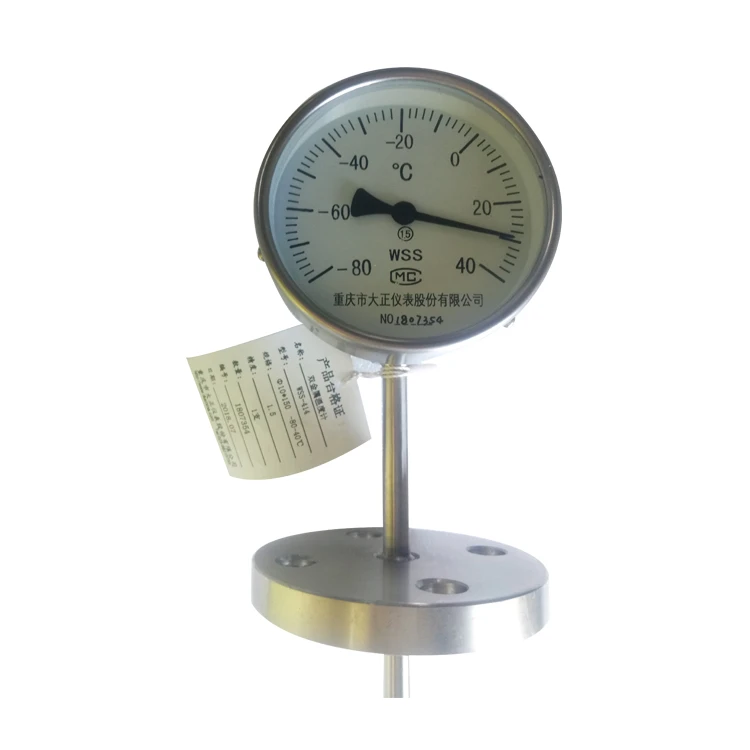
Bimetallic thermometers are a simple, reliable, and cost-effective temperature measuring instrument that requires no external power supply and can maintain measurement accuracy for decades. They are suitable for continuous temperature monitoring in operating conditions that do not require ultra-high measurement accuracy or fast response. We have repeatedly seen such instruments used at boiler room duty stations, residential district heating systems, and secondary process lines in chemical plants; in these locations, even if the sensor fails, it will not directly cause production downtime, but if overheating is not detected in time, it may damage equipment.
How bimetallic thermometers work and why they are still widely used
The core component of the instrument is the bimetallic strip: it is composed of two thin metal strips with different coefficients of thermal expansion tightly bonded together. When heated, one of the metals elongates more than the other, causing the metal strip to bend. This bending deformation drives the pointer on the dial to deflect through a mechanical transmission mechanism. The entire device requires no wires, no microchips, and no calibration data table; it relies on physical principles and a purely mechanical structure.
We have tested dozens of samples under actual operating conditions: temperature range -40 °C to +500 °C, while also including vibration environments and high-humidity environments. Resistance to mechanical shock is its main advantage. Short-term overload will not damage the thermometer, and it is not afraid of dust or condensation; when voltage fluctuations occur in the power grid, its readings will not drift. The above characteristics make it very suitable for use as a secondary monitoring instrument; for example, it can be used in parallel with the electronic sensor of an anode paste sintering furnace.
Application scope of bimetallic thermometers: from utilities to industrial furnaces
The applicable scenarios for bimetallic thermometers do not depend entirely on their own structure, but more on the actual operating conditions. In critical processes, they are rarely used as the primary measuring device, but almost always serve as the "operator's visual observation window":
Thermal energy industry: temperature measurement of heat transfer media in boiler rooms, inlet and outlet temperature monitoring of heat exchangers, domestic hot water systems;
Industrial equipment field: temperature monitoring of pump bearings, compressor oil tanks, reducer housing temperature measurement;
Food and pharmaceutical production: auxiliary temperature monitoring of storage rooms, drying ovens, and steam pipelines;
Laboratories and research institutes: used for visual verification of whether the heating furnace operating condition is stable before starting high-precision formal experiments;
Equipment operation and maintenance: overheating troubleshooting of motors, transformers, and hydraulic systems.
We especially often recommend bimetallic thermometers as redundant backup temperature measuring elements: when the primary digital sensor is connected to an automated process control system (ACS TP), a mechanical thermometer is installed in parallel beside it; even if communication is interrupted, on-site operators can still immediately read the actual on-site temperature.
Limitations of use - which operating conditions should use other temperature measurement solutions
At 1200 °C in vacuum furnace temperature measurement, bimetallic thermometers cannot replace Type K thermocouples; they also cannot achieve the ±0.1 °C measurement accuracy required for calibration of reference sources. The instrument itself has thermal inertia, with response times ranging from 30 seconds to several minutes, so it cannot capture instantaneous temperature spikes.
If your work requirements are: automated data collection, transmission of readings to a SCADA system, or recording heating curves in accordance with the national standard GOST 34986-2022, then bimetallic thermometers cannot perform the above tasks. For such operating conditions, we can provide four-wire PT100 resistance temperature detectors, or Type C thermocouples compliant with AMS2750 and equipped with compensation wires; such products have already been tested and verified in our own laboratory heating furnace at temperatures up to 1700 °C.
However, if you need a field indication instrument that operates reliably, has intuitive readings, does not depend on power supply, requires no complex commissioning, and does not need to be sent for calibration every year, then the bimetallic thermometer is still the optimal choice. Its price is 3-5 times lower than that of digital output temperature measuring instruments; if installed properly, its service life can reach 15-20 years.
Selection and use: points to check before installation
Before purchasing, please focus on three parameters:
Temperature measurement range: when selecting, the range should leave at least a 20% margin above the maximum operating temperature of the equipment;
Connection thread: commonly G1/2″ or M27×2 threads; be sure to confirm that the thread matches the equipment connection joint;
Accuracy class: for ordinary industrial operating conditions, Class 1.5 (error is ±1.5% of the range) is sufficient; for safety-related systems, Class 1.0 must be selected.
Do not install the instrument in direct sunlight or in locations with cross-flow drafts. The insertion depth of the probe must not be less than 60 mm, otherwise the measured reading will be too low. If the thermometer is installed vertically, the dial pointer should face upward; this avoids the effect of the pointer's own weight on the internal mechanical mechanism.