Overview
When sourcing industrial temperature sensors for European and global projects, you will always notice two essential marks: CE and RoHS. Many buyers regard them as simple logos, but they are mandatory compliance proof that determines product legality, operational safety and market eligibility. For industrial equipment integrators, engineering contractors and end manufacturers, choosing sensors with complete CE and RoHS certifications is the basic guarantee for stable equipment operation, staff safety and smooth market sales.
What is CE Certification?
The CE mark is the mandatory market access passport for the European Union (EU) and is accepted throughout the EEA. For industrial temperature sensors, CE certification verifies that the product complies with EU requirements for electrical safety (LVD) and electromagnetic compatibility (EMC).
Certified temperature sensors feature stable performance, strong anti-interference ability and safe circuit design. They can adapt to various complex industrial working conditions and fully meet EU industrial safety specifications, allowing free circulation and legal sale in all EU member countries. Without CE certification, temperature sensors are prohibited from entering the EU market and will face customs detention and order rejection risks.
What is RoHS Certification?
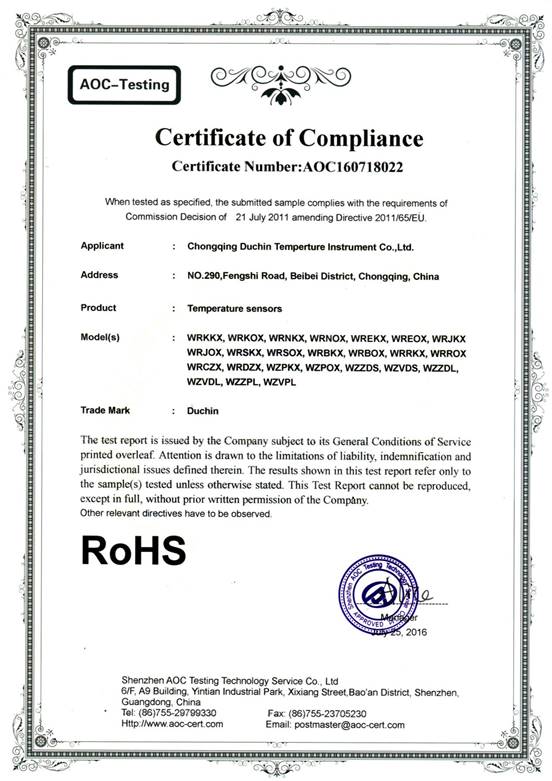
RoHS (Restriction of Hazardous Substances) is a mandatory EU directive for electronic and electrical equipment. It strictly limits the content of hazardous substances such as lead, mercury, cadmium, hexavalent chromium, polybrominated biphenyls (PBB) and polybrominated diphenyl ethers (PBDE) in sensors.
Industrial temperature sensors that pass RoHS certification are low-toxic, environmentally friendly and safe for human health. They avoid potential health hazards for on-site operators during long-term use and reduce environmental pollution during equipment replacement and scrapping. RoHS is an essential green certification for modern industrial equipment and a key assessment standard for global high-standard engineering projects.
Core Value of CE + RoHS Dual Certification
CE focuses on product safety and operational reliability, while RoHS focuses on human health and environmental compliance. The dual certification is not just a badge – it is powerful proof of sensor quality and compliance:
|
Benefit |
Explanation |
|
Market Compliance |
Full EU market access, supporting zero-barrier export and project bidding |
|
Operational Safety |
Standardized circuit and structural design prevent equipment failure and electrical risks |
|
Human & Environmental Protection |
No excessive harmful substances, suitable for food, pharmaceutical, chemical and other high-standard scenarios |
|
Quality Reliability |
Certified products offer stable measurement accuracy and longer service life, reducing after-sales failure rates |
Why Non-Certified Sensors Are a Risk
In industrial procurement, non-certified low-cost sensors often bring hidden risks such as equipment interference, safety accidents, customs clearance failure and project rejection. We strictly implement EU standards, and all our industrial temperature sensors are fully equipped with CE and RoHS official certifications.
Our Products & Support
Our products cover multiple types such as thermocouples, RTDs and customized explosion-proof temperature sensors, supporting global industrial applications. Every product comes with complete test reports and certification files, helping clients eliminate export risks, ensure on-site safe operation and enhance project competitiveness.
Contact Us
If you need certification documents, product parameters or customized solutions for industrial temperature sensors, contact us today for professional support!