


(Integrated Thermocouple / RTD)
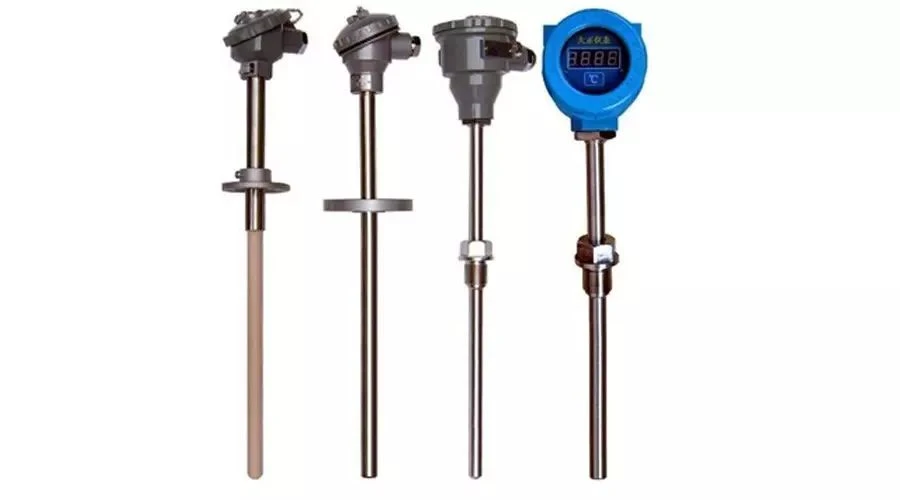
Overview
A thermocouple measures temperature based on the thermoelectric effect, outputting a non-linear mV signal that is converted to a corresponding temperature value by checking its calibration table.An RTD (Resistance Temperature Detector) measures temperature based on the resistance-temperature characteristic of materials, outputting a non-linear resistance signal that is also converted to temperature via a calibration table.
These two non-linear methods requiring calibration table lookup cause many inconveniences in large-scale practical applications, especially limiting computer-based display, calculation, and control.
An integrated thermocouple/RTD with a temperature transmitter is essentially a thermocouple or RTD with a temperature transmitter module installed inside its terminal head.The non-linear signal from the thermocouple/RTD is converted by the transmitter module into a uniform, linear, standardized output signal for easy display, remote transmission, signal sharing, and integrated control.Temperature can be calculated directly without a calibration table, and the product has excellent interchangeability.For example, an integrated thermocouple with a range of 0~300°C can be replaced with an integrated Pt100 RTD with the same 0~300°C range.
Linear relationship: means two variables have a first-order function relationship, expressed as:y=ax+bwhere a and b are constants, and y and x are two variables (e.g., measured medium temperature and output signal).
Working Principle of Temperature Transmitter
Classification of Integrated Thermocouple / RTD
Integrated thermocouples and RTDs add a temperature transmission function or on-site display function to standard thermocouples/RTDs.Specifically, a temperature transmitter module and/or a field display head are installed in the original terminal head.In practical applications, there are 6 types:
|
Description |
Transmitter |
Output Signal |
Local Display |
Connection Type |
Power Supply |
|
Integrated waterproof (splash‑proof, jet‑proof) thermocouple/RTD with transmitter |
Module |
4~20mA |
None |
Waterproof / splash‑proof terminal head |
External 24VDC |
|
Integrated explosion‑proof thermocouple/RTD with transmitter |
Module |
4~20mA |
None |
Explosion‑proof terminal head |
External 24VDC |
|
Integrated thermocouple/RTD with transmitter & local display (explosion‑proof) |
Module |
4~20mA |
LCD digital display |
Local display terminal head |
External 24VDC |
|
Battery‑powered integrated thermocouple/RTD with local digital display |
Conversion circuit |
None |
LCD digital display |
Local display terminal head |
9VDC battery |
|
Integrated thermocouple/RTD with bimetallic thermometer display |
None |
Non‑linear mV or resistance signal |
Bimetallic thermometer |
Waterproof / splash‑proof terminal head |
None |
|
Separately mounted integrated thermocouple/RTD with transmitter & local display |
Module |
4~20mA |
LCD digital display |
Local display terminal head, separate mounting |
External 24VDC |
Temperature Transmitter Module
Types and Codes
|
Item |
TR |
TS |
TH |
TF |
|
Type |
Analog fixed range |
Digital programmable |
Digital HART |
Digital Fieldbus |
|
Input Signal |
Thermocouple / RTD |
Thermocouple / RTD, -125~1200mV, 0~5000Ω |
Thermocouple / RTD, -15~115mV / 0~4000Ω |
- |
|
Output Signal |
4~20mA |
4~20mA adjustable digital |
4~20mA adjustable HART |
Adjustable digital + status |
|
Supply Voltage |
10.5~30VDCEx:10.5~29.4VDC |
10.5~30VDCEx:11.5~29.4VDC |
8.5~30VDCEx:8.5~29.4VDC |
9~32VDCEx:9~17.5VDC |
|
Input‑Output Isolation |
No |
Yes |
Yes |
Yes |
|
Wiring System |
2‑wire |
3‑wire, 4‑wire |
3‑wire, 4‑wire |
3‑wire, 4‑wire |
|
Accuracy |
0.1%, 0.2% |
0.1%, 0.2% |
0.1% |
0.2% |
|
Explosion‑proof |
dIIBT4 |
dIIBT4 |
dIIBT4 |
dIIBT4 |
|
Intrinsically safe |
iIICT6 |
iIICT6 |
iIICT6 |
iaIICT4/T6 |
|
Response Time (s) |
0.5 |
0.5 |
0.5 / configurable 1.3 |
- |
|
Ambient Conditions |
Temperature: -40~75℃, Humidity: 5~95%RH |
Measuring Range of Integrated Thermocouple / RTD
The measuring range of an integrated thermocouple/RTD is directly related to the standard output signal and must be clearly specified during selection.
The range of the temperature transmitter and the measuring range of the thermocouple/RTD are two different concepts:
Measuring range: the maximum working capability
Transmitter range: the actual required working range (a segment within the measuring range)
For example:A Type K thermocouple has a measuring range of 0~1200℃, but the actual operating range is 0~900℃, so the transmitter range can be set to 0~1000℃ corresponding to 4~20mA.
To improve resolution, the range can be narrowed to focus on the main working section.For example, a tungsten‑rhenium thermocouple for temperature control has a measuring range of 0~2100℃, with the main working section at 1400~1600℃.To improve control accuracy, the transmitter range can be set to 1300~1700℃.
Currently, fixed‑range transmitters are widely used; their range cannot be changed once set.Digital programmable and communication‑enabled transmitters allow adjustable input signals and output ranges as needed.
Temperature Calculation
The measuring range and output current are linearly proportional:
Minimum range → 4mA
Maximum range → 20mA
Example:0~600℃ corresponds to 4~20mA.At 200℃:I=4+(20−4)×600200=9.333mAConversely, if the measured current is 9.333mA:℃
Recommended Measuring Ranges
RTDs
Cu50, Cu1000~50, 0~100, 0~150, -50~50, -50~100℃
Pt100, Pt100~50, 0~100, 0~150, 0~200, 0~300, 0~400, 0~500,200~400, 200~500,-50~50, -50~150, -50~200, -100~50, -200~50℃
Thermocouples
K (NiCr‑NiSi):0~300, 0~400, 0~500, 0~600, 0~800, 0~1000, 0~1200, 0~1300℃
N (NiCrSi‑NiSiSi):400~800, 500~1000, 600~1200℃
E (NiCr‑Constantan):0~300, 0~600, 0~800, 200~600℃
J (Fe‑Constantan):0~300, 0~600, 0~800℃
T (Cu‑Constantan):0~100, 0~200, 0~300, -50~100, -200~50℃
S, R (PtRh10‑Pt, PtRh13‑Pt):0~1000, 0~1300, 0~1600, 600~1600℃
B (PtRh30‑PtRh6):600~1600, 600~1800, 800~1600, 1000~1800℃
W3/25 (WRe3‑WRe25):0~1300, 0~1600, 0~2200, 800~1600, 800~1800, 1000~1600℃
W5/26 (WRe5‑WRe26):1000~1800, 1000~2000, 1200~2200℃
Features
Integrated thermocouples/RTDs are advanced products developed from standard thermocouples/RTDs, representing major technical progress in temperature measurement.They are suitable for all applications of standard thermocouples/RTDs and offer the following additional advantages:
Convert non-linear thermocouple/RTD signals into linear, standardized electrical signals.
2‑wire transmission: power and signal share the same two cables.
Transmitter module is encapsulated with epoxy resin, providing corrosion resistance, vibration resistance, low power consumption, and high reliability.
Accuracy up to 0.1%, easier to ensure system accuracy with integrated structure.
Built‑in cold junction compensation and non‑linear correction.
No need for compensation cables or 3‑core equal‑resistance cables; ordinary 2‑core cable can be used, ensuring easy installation and lower cost.
On‑site display function greatly improves on‑site operability.
Adjustable remote transmission and display range, high resolution, high data reliability.
Support digital expansion: programmable, communication‑enabled.
Selection Guide
Steps for selecting an integrated thermocouple/RTD with transmitter or local display:
Select thermocouple or RTD according to the measured medium temperature and working conditions.
Determine the terminal head height or separate mounting based on ambient temperature, dust, and corrosive atmosphere.
If ambient temperature > 60℃ or heavy dust/pollution: separate mounting recommended.
If ambient temperature 50~60℃ or surface temperature high: raise head to ≥250mm.
Choose whether to use local display and the display type according to operation requirements.For long‑distance observation, a model with bimetallic thermometer is recommended.
Select the appropriate transmitter module according to the measurement and control system.For small usage volume and no computer monitoring system, fixed‑range transmitters are more cost‑effective.
Determine the transmitter range based on actual operating temperature.
Express the model correctly according to the model coding method (see product examples).
Chongqing Duchin Temperature Instrument
Your Expert in Temperature Instruments!